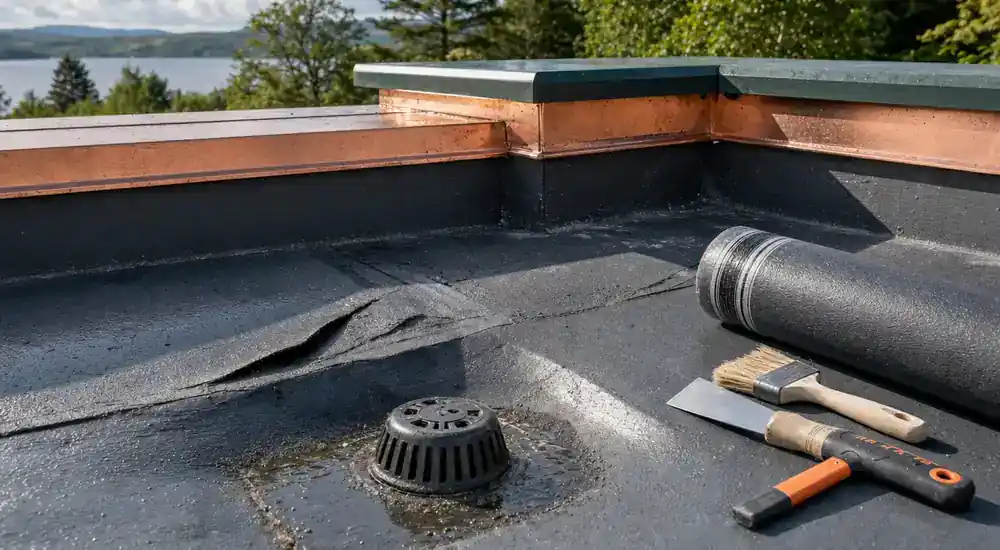
Compare each specification and quote for missing scope, separate confirmed work from opening-up risk and ask the council when Scottish building standards or a building warrant may affect the project.
Compare complete specifications
- Confirm why replacement is being considered and which findings rule out a durable local repair.
- Compare the whole roof build-up and every junction, not just the named surface system.
- Ask the local council about building warrant requirements where structure, insulation or other regulated work may change.
- Make access, occupancy, weather protection, waste and handover information part of the project scope.


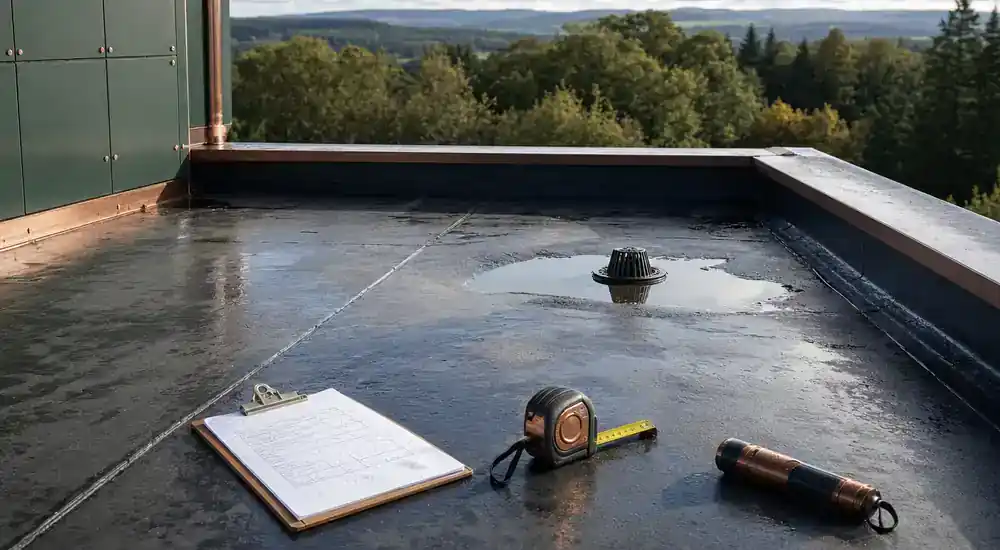
Confirm the replacement decision
Replacement should answer a documented condition problem. Ask whether defects are isolated, repeated or distributed across the covering and build-up, and whether drainage or substrate issues can be corrected locally.
Condition findings
Useful findings cover defect locations, moisture signs, deck movement, previous layers, failed details and repair history where available. Roof age alone does not establish remaining condition, and a leak alone does not establish that the whole roof must be replaced.
Repair comparison
Set out the realistic repair option beside replacement: what it would address, what it would leave, which facts are missing and how future access would work. A transparent comparison prevents replacement from becoming the default merely because the repair scope was never developed.
Specify the complete roof build-up
A proposal should name each layer being retained, removed, repaired or added. Generic wording such as 'new flat roof system' does not explain how moisture, movement or thermal performance will be managed.
Strip-out and deck
List the existing layers, how they will be checked and the deck repair allowance. Where deck condition is concealed, set an inspection point and an agreement process for additional work rather than assuming either a perfect deck or wholesale replacement.
Control layers and insulation
The design should identify the intended build-up, how condensation risk is addressed and how insulation continuity meets the applicable specification. Ask for the basis of the design and do not treat product names as a substitute for junction details.
Covering and protection
The final covering should be identified with its surface treatment, attachment or bonding method, protection during the works and compatibility with adjacent materials. Product-specific limitations should come from the current manufacturer information used for the project.
Design drainage and junctions
Outlets, falls, upstands, rooflights, parapets, thresholds and service penetrations often decide whether the replacement performs as intended. Draw or schedule them so competing proposals are pricing the same details.
Falls and outlets
Show where water is intended to go, whether existing outlets are retained and how overflows or blocked-drainage risk are considered. If the project changes falls or outlet positions, that work belongs in the core scope.
Edges and abutments
List perimeter trims, wall junctions, door thresholds, rooflights, pipes and plant supports. Clarify who is responsible for related masonry, glazing, joinery or service work where the waterproofing depends on it.
Check Scottish standards and approvals
Building regulations apply to building work in Scotland, and the local council building standards team can advise whether the planned work needs a building warrant. The answer depends on the actual scope, so ask with a description of structural, insulation and drainage changes rather than only the phrase 'replace a roof'.
Questions for building standards
State whether the deck or structure changes, whether insulation is added or altered and whether the project forms part of a wider conversion or extension. Keep the council response with the property paperwork.
Traditional or protected properties
If the roof belongs to a listed building or a property in a conservation area, material and appearance decisions may also need planning authority advice. Keep that consent route separate from the building standards question.
Planning access, sequence and weather protection
The project plan should show how the roof is reached, how people and spaces below are protected and how the building remains weather-protected between stages. HSE guidance requires suitable planning and controls for work at height and fragile surfaces.
Access and site constraints
Identify scaffold or other access assumptions, edge protection, fragile rooflights, delivery routes, storage, waste removal and any shared access. Occupied homes and commercial premises may also need agreed working zones and protection below openings.
Strip-out sequence
Ask how much roof will be opened at once, what happens if concealed defects are found and what temporary covering is available if work pauses. This is a practical scope item, not an attendance or weather guarantee.
Compare proposals and the handover package
Put proposals into a common schedule before comparing totals. Every bidder should respond to the same roof areas, layers, details, access assumptions and provisional items.
Comparison schedule
Cover survey findings, opening-up, strip-out, deck work, control layers, insulation, covering, outlets, edges, penetrations, access, protection, waste and associated trades. Mark omissions rather than silently treating them as part of the price.
- Confirmed quantities separated from provisional quantities.
- Manufacturer and product information identified for the proposed system.
- Responsibility for design decisions and associated trades made clear.
- Change-control method stated before concealed work begins.
At handover
Ask which photographs, product details, maintenance information and approval documents you will receive. These help future inspection and do not replace checking the actual contractual terms offered for the project.
Official guidance and references
- mygov.scot: building regulations Scottish public guidance on building regulations, building warrants and contacting the council building standards team.
- Scottish Government: building standards Current Scottish building standards guidance and technical handbooks for domestic and non-domestic work.
- HSE: working at height safely Official guidance on planning, competence, equipment and the hierarchy for controlling work-at-height risk.
- HSE: roof work Official roof-work guidance covering safe access, roof edges, weather and fragile materials.
- HSE: fragile surfaces Official guidance on treating roof surfaces as fragile until a competent person confirms otherwise.
- Historic Environment Scotland: listed building and conservation area consent Current Scottish guidance on changes to listed buildings, conservation areas and the planning authority's role.