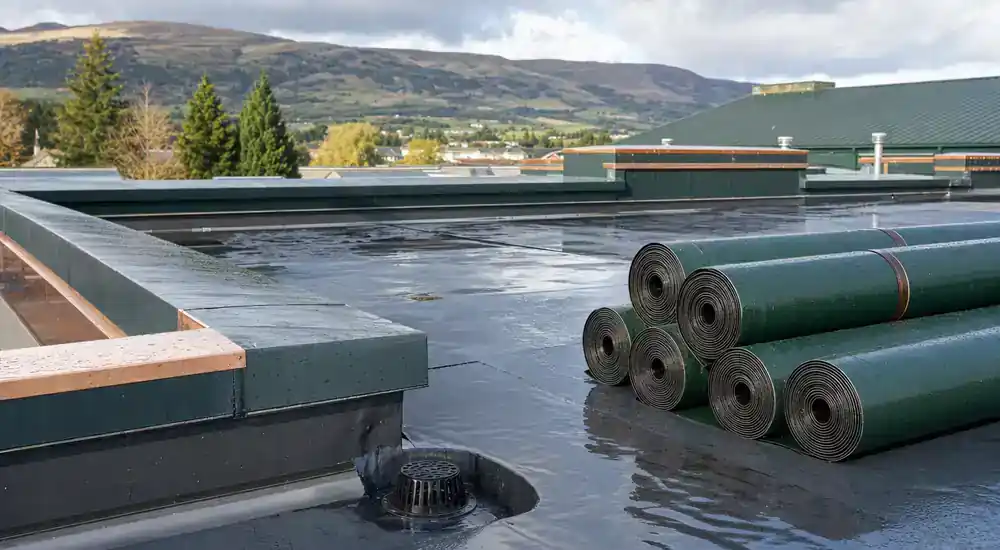
Place the work into a practical scope category before comparing written proposals. A fixed figure before roof condition, access and opening-up findings are known would hide the assumptions most likely to change the work.
Why one leak can lead to very different quotes
- Separate diagnosis, temporary protection and permanent repair in the written scope.
- Ask what is assumed about the deck, insulation, outlets and previous layers before comparing totals.
- Treat safe access, edge protection and occupied-space controls as part of the work, not an afterthought.
- Use a replacement comparison only when defects are widespread or a durable local repair cannot be defined.
Place the work in the right scope category
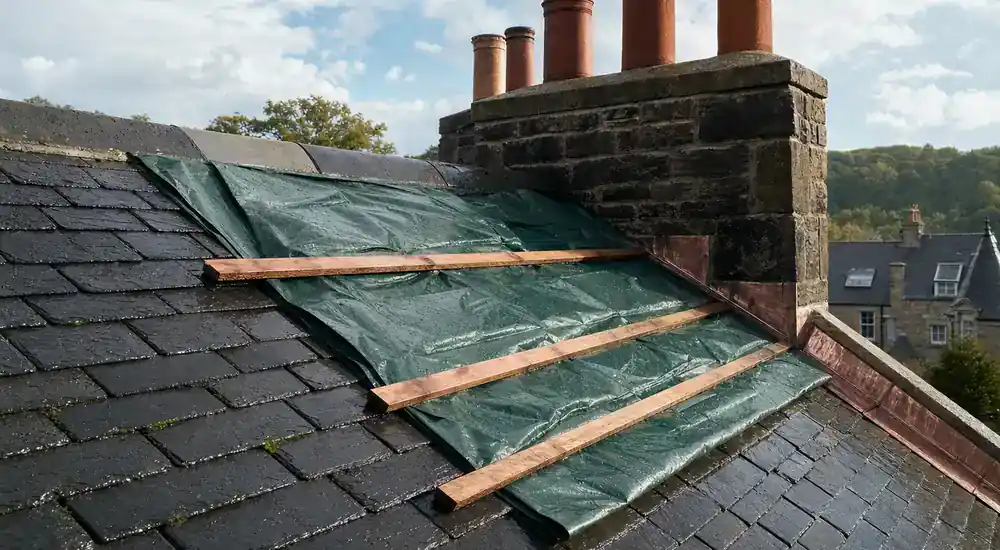
Before asking what a repair costs, decide what is actually being priced. A diagnostic visit, temporary weather protection, a contained membrane repair and a repair involving wet insulation or deck replacement are different scopes even when they begin with the same leak report.
Diagnosis before pricing
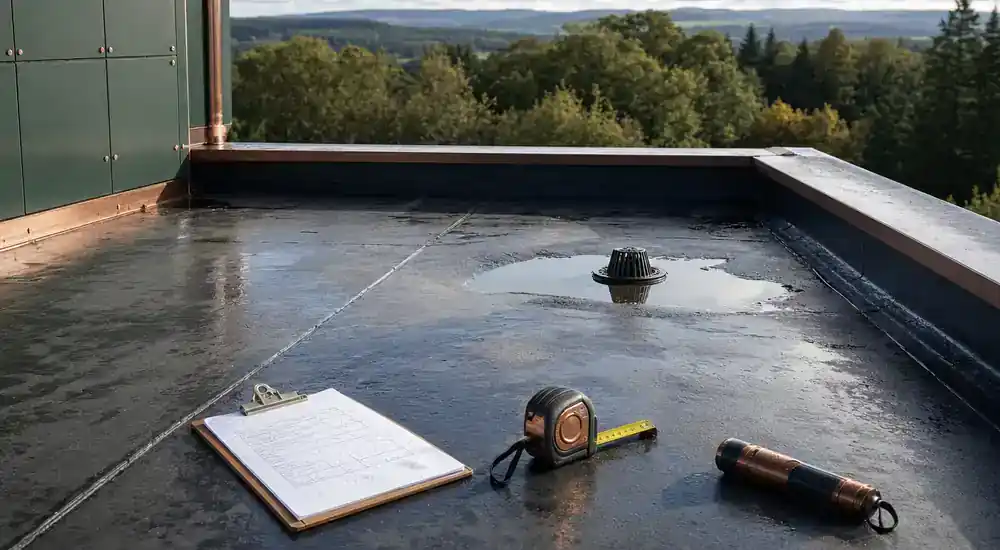
Use this category when the entry point is uncertain, the stain is remote from the likely defect or several details could be involved. The useful result is a clear account of observations, limitations, likely water paths and the next investigation, not a promise that every concealed condition has been found.
Contained local repair
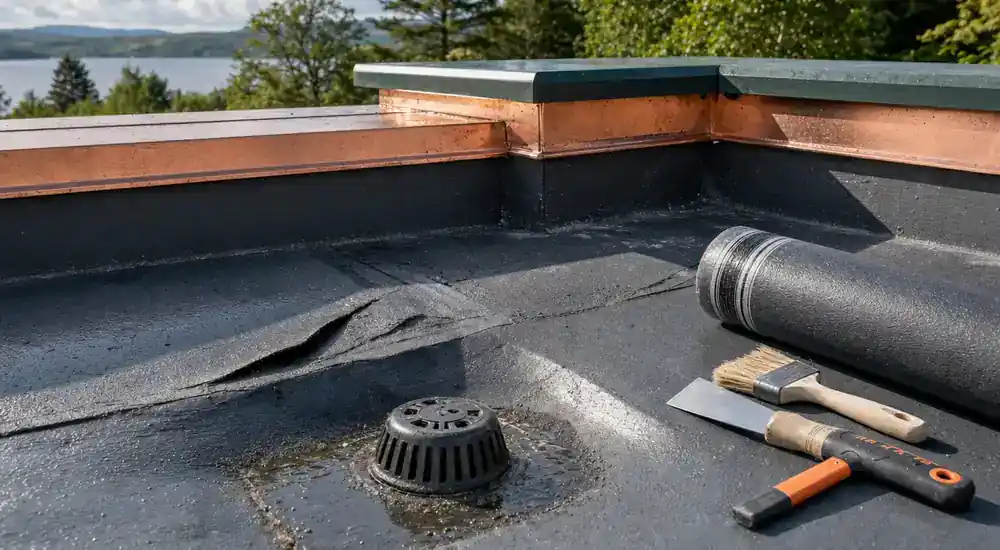
A local scope is coherent when the defect can be defined, compatible repair materials are known and the surrounding covering and substrate appear serviceable. The proposal should identify surface treatment, repair extent and how the repaired detail will connect to the existing system.
Repair with opening-up
If moisture may have entered insulation or decking, the quote should state the opening-up allowance and how extra affected material would be shown and agreed. This turns an unknown into a controlled decision instead of hiding it inside a vague allowance.
Trace the factors that change repair scope
Cost pressure normally follows labour, materials, access and uncertainty. A modest roof area can still contain several labour-intensive junctions, while a larger clear area may have a simpler repair boundary.
Covering and compatibility
Check whether the covering is felt, EPDM, GRP, single ply or another system, along with any known product details and previous coatings. Surface treatment and compatibility need to be specified rather than inferred from appearance alone.
- Puncture, split, blister, crack or failed seam.
- Previous patch, coating or overlay at the same location.
- Unknown system where a compatible detail must be confirmed.
Junctions and drainage
Outlets, rooflights, parapets, abutments, trims and service penetrations can concentrate water and require more detailed work than an open membrane area. Ponding also raises a separate question: whether the repair addresses only a leak or also the falls and drainage that contribute to repeated wetting.
Deck and insulation
Movement, softness, decay or trapped moisture can widen a repair after the covering is lifted. Ask the quote to distinguish confirmed work from provisional work that depends on what opening-up reveals.
Decide whether repair still makes sense
The repair decision should test whether one defined intervention can reconnect sound materials and details. It should not be based only on roof age or the number of patches visible from a distance.
When a local repair fits
A contained defect, serviceable surrounding membrane, stable substrate and functioning drainage support a local route. The quote should still note nearby details that were checked but sit outside the repair boundary.
When to compare wider work
Repeated leaks in different places, widespread loss of adhesion, extensive moisture, failing edges or a build-up that cannot be repaired compatibly are reasons to compare a replacement scope. That comparison is a planning step, not a claim that replacement is automatically required.
Account for access and property constraints
HSE guidance requires work at height to be planned, supervised and carried out by competent people using suitable equipment. A quote should therefore explain the assumed access route and controls where they materially affect the work.
Roof-edge and fragile-surface controls
Do not assume that a short task or a flat surface removes fall risk. Rooflights, weak decking and roof edges can alter the access method; HSE advises treating roofs as fragile until a competent person has confirmed otherwise.
Occupied and shared buildings
Roof-hatch access, rear lanes, keys, parking, a tenement factor, tenant coordination and areas below the work can all affect sequencing. These facts should be visible in the proposal rather than discovered on the day.
Compare written quotes line by line
Compare the same scope and exclusions, not just the final total. A shorter proposal may omit work that another has made explicit, so ask for clarification before treating the figures as equivalent.
Scope lines to look for
The document should identify investigation, surface treatment, repair extent, compatible materials, junction details, access, protection below, waste, photographs and any follow-up check.
- Confirmed work and provisional work shown separately.
- Assumptions about deck, insulation and previous layers.
- Temporary protection distinguished from permanent repair.
- Exclusions and responsibility for associated internal work.
Questions that reveal uncertainty
Ask what finding would change the scope, how a change is shown and agreed, and whether the roof can be left weather-protected while that decision is made. Clear answers make a quote more useful even when concealed conditions remain unknown.
Start a repair conversation without climbing
Photograph the roof only from ground level, a normal window or another safe position. Pair images with a short timeline showing when water appears, which rooms are affected and whether previous work is known.
- Property type and whether the roof is over occupied space.
- Leak timing: constant, wind-driven, after prolonged rain or after a storm.
- Wide view of the roof and safe close views of visible details.
- Internal marks, approximate location and whether they are changing.
- Known covering, roof age or earlier repair information, clearly labelled as known or uncertain.
- Access constraints and any immediate falling-material concern.
Official guidance and references
- HSE: working at height safely Official guidance on planning, competence, equipment and the hierarchy for controlling work-at-height risk.
- HSE: roof work Official roof-work guidance covering safe access, roof edges, weather and fragile materials.
- HSE: fragile surfaces Official guidance on treating roof surfaces as fragile until a competent person confirms otherwise.
- mygov.scot: building regulations Scottish public guidance on building regulations, building warrants and contacting the council building standards team.
- Scottish Government: building standards Current Scottish building standards guidance and technical handbooks for domestic and non-domestic work.